
Technical Guides · 9 min read · Updated 2026-07-15
Warehouse floor line marking colours: what they mean and how to apply them
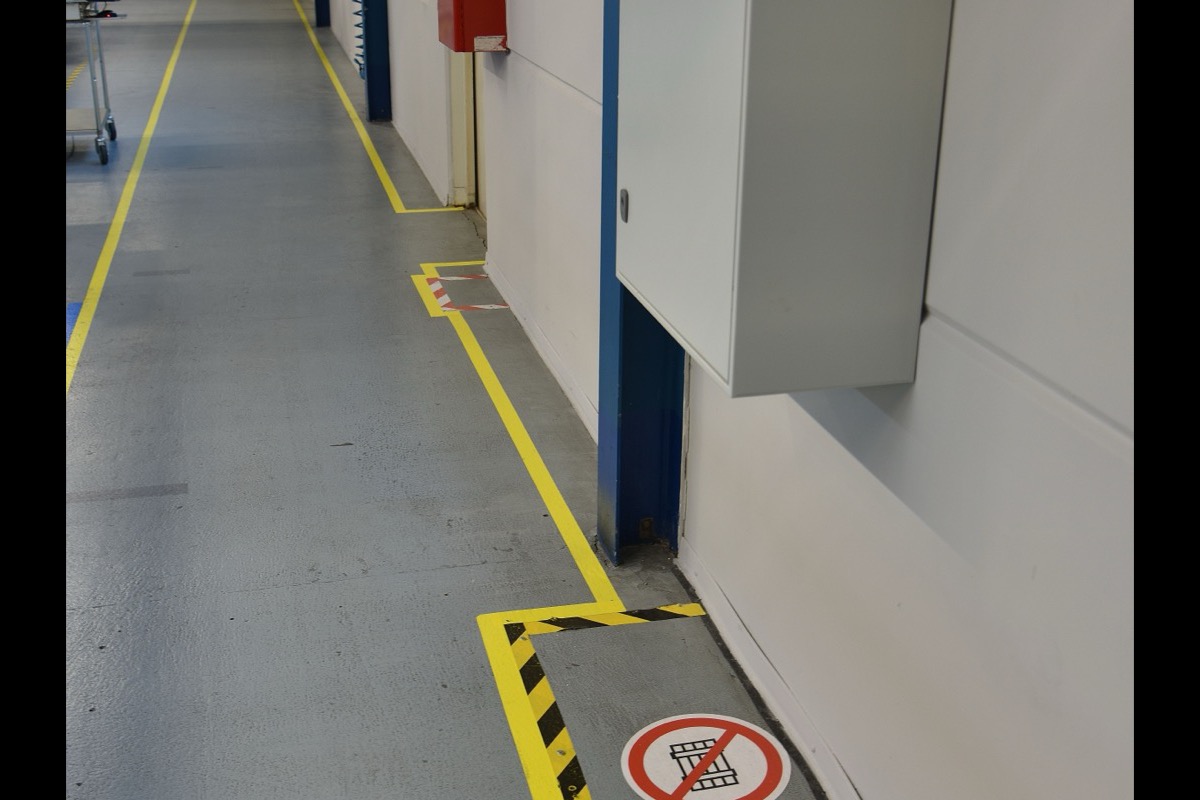
Answer summary
Warehouse floor line marking uses colour to separate people from vehicles and to flag hazards and keep-clear zones. There is no single Singapore-mandated colour code: the colour scheme most warehouses use (yellow aisleways, red for fire equipment, blue for materials) is the widely adopted OSHA/5S convention, while the underlying meaning of each safety colour follows ISO 3864-1:2011. Under the WSH Act 2006, occupiers have a general duty to keep floors safe and demarcated, so the practical goal is clear, durable, high-contrast markings that everyone reads the same way.
What floor line marking is for
Floor line marking turns an open warehouse slab into a legible, rule-based space. Its first job is to segregate pedestrian and vehicle traffic: dedicated walkways keep people out of forklift and reach-truck paths, and marked aisleways give vehicles a defined lane so racking, staging and travel routes do not overlap by accident. In a multi-shift Singapore facility running long hours, that separation is often the single biggest contributor to floor-level safety.
Beyond traffic, markings define hazard and keep-clear zones — the swept area in front of fire extinguishers, hose reels and fire exits, the clearance around electrical panels and isolators, and any pinch points or drop-offs. They also mark storage and staging footprints (where a pallet, cage or bin belongs) and can show direction of travel, so goods flow through the building rather than piling up at bottlenecks.
Because a warehouse is a working environment under the WSH Act 2006, the occupier carries a general duty to keep floors safe and demarcated. The Act does not prescribe a colour palette; it sets the outcome. Line marking is how that outcome is delivered on the floor, which is why the colours you choose and how durably you apply them both matter.
The colour convention and what each colour signals
Two different things are in play, and it helps to keep them apart. The meaning of a safety colour — what red, yellow, green or blue signifies — follows ISO 3864-1:2011: red for fire equipment, prohibition and high hazard; yellow for caution and physical hazards; green for safe conditions and first aid; blue for mandatory action. Hazard areas are shown with 45° alternating stripes, most commonly yellow and black. ISO 3864 is the right reference for colour meaning.
The specific warehouse floor-marking scheme — yellow for aisleways and traffic lanes, red for anything to do with fire equipment, blue for materials and tools, and so on — is not law in Singapore. It is the widely adopted OSHA/5S convention (drawn from US OSHA practice under 29 CFR 1910 and the 5S workplace-organisation method) that most facilities standardise on because it is familiar and consistent. There is no single SG-mandated floor-marking colour code, so the value comes from picking one convention and applying it uniformly across the site.
The table below sets out the common convention. Treat it as best practice aligned to ISO 3864 colour meaning, not as a legal requirement. What matters most is that every colour means the same thing in every aisle, and that contractors, staff and visitors are told the scheme.
| Colour | Common meaning (OSHA/5S convention) | Typical warehouse use |
|---|---|---|
| Yellow | Caution / physical hazard (ISO 3864) | Aisleways, traffic lanes, walkway edges, general work-cell boundaries |
| Red | Fire equipment / prohibition / high hazard (ISO 3864) | Keep-clear zones at extinguishers, hose reels, fire exits; defect/reject areas |
| Blue | Mandatory action (ISO 3864) | Materials, components, tools, work-in-progress and equipment storage |
| Green | Safe condition / first aid (ISO 3864) | First-aid points, safety stations, safe-area or finished-goods footprints |
| Orange | Caution (convention) | Materials or product held for inspection; energised / caution equipment |
| Yellow-black 45° stripes | Physical hazard area (ISO 3864 hazard striping) | Pinch points, low clearance, ramps, drop-offs, do-not-block hazard zones |
Line width, contrast and 45° hazard striping
A marking only works if it is seen and understood. Line width and contrast come from the same OSHA/5S convention rather than SG law: aisle and boundary lines are typically drawn in the region of 50 to 100 mm wide, wide enough to read from a moving forklift and to survive some wear, with the exact width chosen for the traffic and sightlines in each area. The principle to hold onto is legibility under real conditions — dust, tyre scuffing and low light — not a specific number.
Contrast matters as much as width. A yellow line on a pale, dusty slab disappears; the same line on a darker sealed or coated floor reads clearly. Where the floor itself is light, a contrasting border or a coated base helps the lines stand out. Hazard areas use 45° alternating stripes — classically yellow and black — because the diagonal pattern reads as danger from any approach angle and is hard to mistake for a plain boundary line.
Direction-of-travel arrows, footprints and text (for example numbered bay identifiers) extend the same system. Keep them consistent in size and colour with the lines around them so the whole floor reads as one language rather than a patchwork of contractor habits.
How markings are applied: bonded coating lines vs tape
There are two broad ways to put a line on a floor. Adhesive floor-marking tape is fast, needs no cure and can be lifted and relocated, which suits offices, light-traffic zones and layouts that change often. Its weakness is heavy vehicle traffic: under repeated forklift and reach-truck wheel loads, tape edges lift, tear and peel, especially where wheels turn or brake on the line.
The more durable route is line-marking paint or coating applied into or onto the floor coating itself. A bonded coating line becomes part of the floor system rather than a layer sitting on top, so it resists the shear and abrasion of forklift traffic far better and lasts longer between refreshes. Sparco supplies floor coatings and can provide line marking within a coated-floor scheme, so aisle lines and hazard zones are laid as part of the same durable system rather than added as an afterthought.
The trade-off is discipline. A bonded line needs the same surface preparation and cure control as any coating: the substrate must be mechanically prepared and clean, moisture must be within limits, and the line must be allowed to cure before traffic returns. That is a fair exchange for a marking that stays put under the wheels that would have destroyed tape. Surface preparation and moisture testing are covered in our concrete surface preparation guide and moisture testing article; the same rules apply to a line as to a full coat.
Common mistakes
Most floor-marking problems are avoidable and trace back to a handful of recurring errors. The biggest conceptual one is treating the US OSHA colour scheme as a Singapore legal requirement. It is a widely adopted convention, not law; the enforceable duty under the WSH Act 2006 is to keep floors safe and demarcated, and colour meaning follows ISO 3864. Present it to staff honestly as the site standard, and it will hold up better than a misremembered rule.
- Treating the OSHA/5S colour scheme as SG law — it is a convention; the WSH Act 2006 sets the duty and ISO 3864 sets colour meaning.
- Using tape in a heavy forklift lane, where edges lift and peel within weeks.
- Marking over an uncoated or dusty floor, so the line never bonds and quickly peels.
- Lines too narrow or too low in contrast to be read from a moving vehicle.
- No plan or budget to refresh worn markings, so the scheme degrades until it is ignored.
Floor line marking checklist
Use this checklist to plan a marking scheme that is legible, durable and consistent across the whole site. Work through it before any line goes down, because the mapping and colour decisions drive everything after them.
- Map the floor: pedestrian routes, forklift and reach-truck paths, aisles, hazards, fire equipment and electrical panels.
- Pick one colour convention (OSHA/5S) and document what each colour means, aligned to ISO 3864.
- Set line widths and contrast for real conditions — readable from a moving vehicle, distinct from the slab.
- Decide application: bonded coating lines for heavy-traffic lanes, tape only where layouts change often and traffic is light.
- Confirm the floor is prepared, clean and within moisture limits before applying bonded lines; allow full cure.
- Use 45° hazard striping for pinch points, ramps, drop-offs and do-not-block zones.
- Brief staff on the scheme and set a refresh interval so worn lines are renewed, not ignored.
-
Map traffic & hazards
Pedestrian vs forklift, fire/electrical, aisles
-
Choose colour convention & widths
ISO 3864 meaning + OSHA/5S scheme
-
Prepare & coat the floor
Clean, mechanically prepped, moisture within limits
-
Apply bonded line marking
Lines and hazard stripes cured before traffic
-
Maintain & refresh
Renew worn lines on a set interval
The mapping step decides everything downstream — get the traffic and hazards right first.
When to use this system
- Setting up 5S or traffic segregation in a new or reorganised warehouse.
- Separating pedestrians from forklift and reach-truck routes.
- Marking keep-clear zones at fire equipment, exits and electrical panels.
- Replacing tape that keeps peeling under vehicle traffic with bonded lines.
Where it is commonly used
- Distribution centres and logistics warehouses with forklift traffic.
- Aisleways, walkways and staging or storage footprints.
- Hazard zones: ramps, pinch points, drop-offs and do-not-block areas.
- Coated production and warehouse floors where lines are laid within the coating.
Related Sparco products
Recommended TDS downloads
Browse the TDS Download Centre →Related market segments
Manufacturing & Warehousing
Production floors and warehouses take forklift traffic, impact, spills and around-the-clock operations. Sparco's full flooring range — from bonding primers and repair mortars to self-smoothing epoxies and polyurethane topcoats — keeps industrial floors serviceable with minimal downtime.
Automotive
Automotive refinishing demands clear coats with fast drying, high gloss and lasting resistance to weather, solvents and polishing. Sparco's 2K polyurethane acrylic clear lacquer range covers standard, fast-dry and MS clear systems for professional body shops.
Related solutions & guides
Frequently asked questions
Is there a legal floor marking colour code in Singapore?
No single colour code is mandated in Singapore. The WSH Act 2006 places a general duty on occupiers to keep floors safe and demarcated, but it does not prescribe specific colours. Most warehouses adopt the widely used OSHA/5S convention for the scheme, while the meaning of each safety colour follows ISO 3864-1:2011.
What do the floor marking colours mean?
Under the common convention aligned to ISO 3864, yellow marks aisleways and general caution, red marks fire equipment and prohibited or high-hazard areas, blue marks materials and tools, and green marks first aid and safe conditions. Yellow-and-black 45° stripes mark physical hazard areas such as pinch points and ramps. Apply one consistent scheme across the whole site.
Should I use floor marking tape or painted lines in a warehouse?
It depends on traffic. Tape suits light-traffic areas and layouts that change often because it installs fast and lifts cleanly. In heavy forklift or reach-truck lanes, tape edges peel, so a bonded line-marking paint or coating that becomes part of the floor system lasts far longer — provided the floor is prepared and the line is allowed to cure.
How wide should warehouse floor marking lines be?
The OSHA/5S convention typically uses lines in the region of 50 to 100 mm wide, chosen so they read clearly from a moving forklift and survive wear. There is no single Singapore-mandated width; the guiding principle is legibility under real conditions of dust, scuffing and low light, with wider or higher-contrast lines where sightlines are poor.
Do bonded line markings need the same floor preparation as a coating?
Yes. A bonded line is a coating, so it needs the substrate mechanically prepared, clean and within moisture limits, and it must cure before traffic returns. Marking over a dusty or uncoated floor is the most common reason lines peel. See our concrete surface preparation and moisture testing articles for the underlying requirements.
How often should floor markings be refreshed?
There is no fixed interval; it depends on traffic intensity, cleaning regime and how the lines were applied. Heavily trafficked forklift lanes wear faster than pedestrian walkways, and bonded coating lines generally outlast tape. Set a routine inspection and refresh schedule so markings are renewed before they fade to the point of being ignored.
Related guides
Related project references
Anonymised references from real Sparco projects show how these systems are applied on comparable sites.
Browse project references →Values referenced in this guide come from the products' Technical Data Sheets. Final specification depends on substrate, traffic, chemical exposure and shutdown window — confirm the complete build-up with our technical team.