
Industry Applications · 7 min read · Updated 2026-07-15
Epoxy flooring for warehouse buildings in Singapore: a system guide
Answer summary
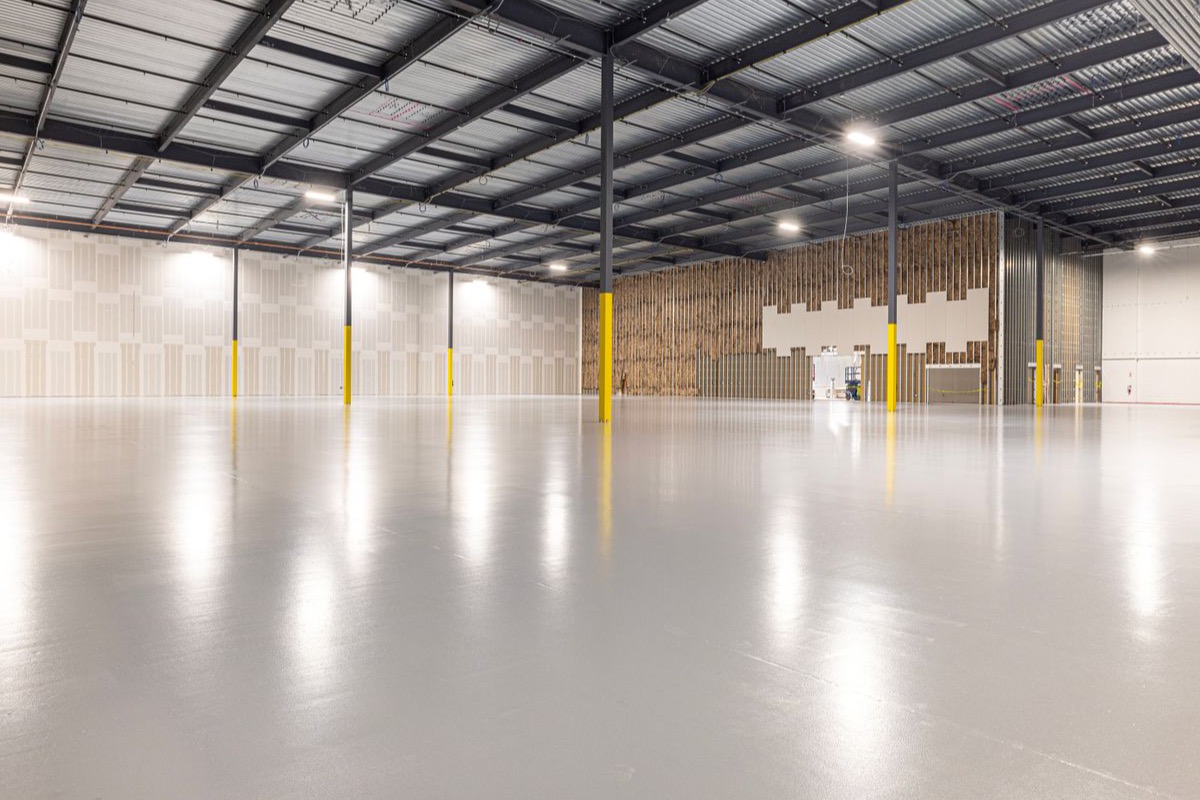
Epoxy flooring for a warehouse in Singapore means matching a floor coating to the duty of each zone rather than coating the whole slab to one spec. Thin roller-applied epoxy suits light storage aisles, self-smoothing epoxy suits mixed traffic that needs a seamless finish, and a high-build epoxy or polyurethane screed suits heavy forklift lanes, wet or chemical areas and cold stores. Surface preparation and moisture testing decide whether any of these systems lasts.
Why warehouses coat bare concrete at all
A power-floated concrete slab looks hard-wearing, but bare concrete dusts under traffic, absorbs oil and chemical spills, and abrades where forklift and reach-truck wheels turn and brake. In a Singapore warehouse running multiple shifts, that surface wear becomes airborne dust on stock, a cleaning burden, and eventually spalled concrete that damages wheels and pallets.
A warehouse floor coating is applied to solve a defined set of problems: dust control by sealing the concrete surface; abrasion and impact resistance under wheeled traffic; cleanability of a non-porous surface; light reflectance that lifts illumination in aisles without adding fixtures; durable line marking for traffic lanes and racking; and spot resistance to the chemicals a given zone actually handles.
The point of this guide is that no single film does all of this equally well across a whole warehouse. The right specification changes zone by zone, and the sections below set out the main system choices and what decides between them.
The main system choices at a glance
Most warehouse floors are coated with one of three broad system families. Thin roller-applied epoxy is a two-coat film measured in a few hundred microns, laid over prepared concrete for dust control and light-to-moderate traffic. Sparcofloor #102, a solvent-free high-solids roller epoxy, and the water-based Sparcofloor WBE 400 sit in this family; Sparco's TDS lists WBE 400 for warehouse flooring, production floors and car park decks over substrates of at least 25.0 N/mm² compressive strength.
Self-smoothing epoxy is trowel- or gauge-applied at a higher build to give a seamless, easily cleaned surface with better mechanical properties. Sparcofloor SL 200 is a solvent-free, two-component self-smoothing epoxy that Sparco's TDS describes as having high chemical resistance and high mechanical properties. High-build polyurethane screed is the heaviest-duty family, for thermal shock, wet processing and the hardest forklift wear; Sparco 3-C Polyurethane Screed is a water-based hybrid PU screed that Sparco's TDS notes for good levelling and high chemical resistance.
What decides between them is duty, not preference: the type and weight of traffic, chemical exposure, whether the area is wet or subject to temperature change, how much downtime the operation can spare, and the moisture condition of the slab. A forklift lane and a general storage aisle have genuinely different requirements, which is why coating both to the same low spec is a false economy.
-
Assess the slab
Condition, soundness and moisture
-
Match the system to the duty
Traffic, chemicals, wet, downtime by zone
-
Prepare mechanically
Grind or blast to a sound profile
-
Apply primer and build coats
Primer then the chosen film build
-
Line-mark and return to service
Demarcate lanes, then phase reopening
The decision that carries the whole job is matching the system to the duty of each zone.
Matching the system to the zone
The most useful way to specify a warehouse is to divide it into zones by duty and choose a system for each. General storage aisles carry mostly pedestrian and pallet-truck traffic and need dust control and cleanability, not maximum film build. Heavy forklift and reach-truck lanes concentrate load and turning wear along narrow paths and justify a thicker, tougher system. Battery-charging, decanting and dosing areas see acid or solvent contact and need genuine chemical resistance in a seamless finish.
Cold stores and blast freezers move through large temperature swings, where a rigid epoxy is more prone to cracking and delamination and a polyurethane screed is the usual choice; the cold-storage sub-article covers this in detail. Loading bays and ramps are wet from rain and washdown and sloped, so anti-slip finish and slip classification matter more there than anywhere else in the building.
The table below summarises this. Treat the "why" as a pointer, not a full specification: the sub-articles named in this cluster carry the detail for cost, forklift lanes, cold storage and flatness.
| Warehouse zone / duty | Typical system choice | Why |
|---|---|---|
| General storage aisles | Thin roller-applied epoxy | Dust control and cleanability under light traffic |
| Heavy forklift / reach-truck lanes | Self-smoothing or high-build epoxy | Concentrated load and turning abrasion |
| Battery-charging / decanting (chemical) | Self-smoothing epoxy or PU screed | Seamless surface with real chemical resistance |
| Cold store / blast freezer | Polyurethane screed | Tolerates thermal shock better than rigid epoxy |
| Loading bays and ramps | Anti-slip epoxy or PU finish | Wet, sloped surface needs slip resistance |
Surface prep and moisture testing decide the outcome
Whichever system is chosen, the coating can only be as good as the concrete under it and the bond to it. Concrete must be mechanically prepared by diamond grinding, milling or shot blasting to remove laitance and open a sound profile; Sparco's TDS for the Sparco Epoxy Bonding Primer #100, for example, calls for mechanical preparation and a minimum prepared-substrate pull-off strength of 1.5 N/mm². Preparation is covered fully in the concrete-surface-preparation-guide and is not repeated here.
Moisture is the other silent failure. A slab-on-grade with no working damp-proof membrane can drive moisture up through the coating and blister it, and warm Singapore slabs under high ambient humidity make this a live risk; the Sparco Epoxy Bonding Primer #100 TDS sets a maximum permissible substrate moisture content of 5%. Test before you coat, following the concrete-moisture-testing-before-coating guide, rather than assuming a floor that looks dry is dry.
Phasing a coating job in a live, 24/7 warehouse
Few Singapore warehouses can close entirely, so most coating work is phased. The practical approach is to divide the floor into bays that map to operational zones, decant or re-slot stock away from the working bay, and coat during the longest available window, which is often nights or weekends. Fast-cure systems are sometimes specified specifically to shorten the return-to-service time and are treated in the cost sub-article.
Sequence matters as much as scheduling: preparation generates dust and slurry that must be contained away from live racking, primer and build coats each need their own cure interval before traffic, and line marking is laid last. Agree the return-to-service criteria in writing before work starts, because a floor walked or driven on too early is a common and avoidable failure. For the trade-offs between system families here, see epoxy-vs-polyurethane-flooring and pu-screed-flooring.
Common mistakes and a specification checklist
Most warehouse floor disappointments trace back to a handful of specification errors rather than bad products. The mistakes below recur across sites, and the checklist that follows is the short version of everything above.
- Mistake: coating the whole warehouse to one low spec regardless of zone duty
- Mistake: skipping moisture testing on a slab-on-grade and blistering the film
- Mistake: buying the thinnest system for a heavy forklift or reach-truck lane
- Mistake: ignoring anti-slip and line marking at wet ramps and loading bays
- Checklist: zone the floor by traffic, chemical and wet duty before specifying
- Checklist: confirm slab soundness and moisture content against the product TDS
- Checklist: match film build and system family to the heaviest duty in each zone
- Checklist: agree preparation method, cure intervals and return-to-service criteria in writing
- Checklist: specify slip class and line marking for ramps and traffic lanes
When to use this system
- Planning a new warehouse floor or re-coat across mixed zones
- Deciding between thin epoxy, self-smoothing epoxy and PU screed
- Scoping a phased coating job in a live 24/7 facility
- Writing a specification that different contractors can quote fairly
Where it is commonly used
- General storage and pick aisles
- Heavy forklift and reach-truck traffic lanes
- Battery-charging, decanting and chemical-handling areas
- Loading bays, ramps and cold-store zones
Related Sparco products
Recommended TDS downloads
Browse the TDS Download Centre →Related market segments
Manufacturing & Warehousing
Production floors and warehouses take forklift traffic, impact, spills and around-the-clock operations. Sparco's full flooring range — from bonding primers and repair mortars to self-smoothing epoxies and polyurethane topcoats — keeps industrial floors serviceable with minimal downtime.
Retail
Retail floors must look consistently good under continuous footfall, trolley traffic and daily cleaning. Sparco's epoxy and polyurethane systems balance durability with appearance, keeping front-of-house and back-of-house floors presentable and serviceable.
Related solutions & guides
Frequently asked questions
What type of epoxy flooring is best for a warehouse?
There is no single best type; the right system depends on the duty of each zone. Thin roller-applied epoxy suits light storage aisles, self-smoothing epoxy suits mixed traffic needing a seamless finish, and a high-build epoxy or polyurethane screed suits heavy forklift lanes, wet areas and cold stores. Zoning the floor by traffic, chemical exposure and moisture is the correct starting point.
Do I need to coat my whole warehouse to the same specification?
Usually not, and doing so is a common false economy. Different zones carry different traffic, chemical and wet duties, so coating a general aisle to a forklift-lane spec wastes money while coating a forklift lane to an aisle spec fails early. It is more cost-effective to specify each zone to its actual duty.
Can a warehouse floor be coated without shutting the whole building?
Yes. Most Singapore warehouses phase the work bay by bay, decanting stock away from the working area and coating during nights or weekends. Fast-cure systems can shorten the return-to-service window, but preparation dust, cure intervals and line marking still have to be sequenced, so agree return-to-service criteria before work begins.
Is epoxy flooring suitable for a cold store?
Rigid epoxy is more prone to cracking and delamination under the large temperature swings and thermal shock of a cold store, so a polyurethane screed is the usual choice there. The specific system, thickness and temperature range should be confirmed through technical review against the operating conditions. The cold-storage sub-article in this cluster covers the trade-off in detail.
How long does an epoxy warehouse floor last?
Service life depends far more on preparation, moisture control and whether the system matched the zone duty than on the product alone. A correctly specified and prepared floor in an appropriate zone can serve for many years, whereas an under-specified film in a forklift lane, or one applied over an untested wet slab, can fail within months. Service life should be confirmed against the site's traffic and exposure.
Related guides
Related project references
Anonymised references from real Sparco projects show how these systems are applied on comparable sites.
Browse project references →Values referenced in this guide come from the products' Technical Data Sheets. Final specification depends on substrate, traffic, chemical exposure and shutdown window — confirm the complete build-up with our technical team.