
Waterproofing & Protective Coatings · 8 min read · Updated 2026-07-22
RC flat roof waterproofing in Singapore: a system that survives the monsoon
Answer summary
RC flat roof waterproofing in Singapore is a coating system, not a single product: you repair defects, correct falls to drain, prime a clean substrate, apply a seamless flexible body coat, then a UV-stable finish. Most flat roofs leak at outlets, upstands, parapets and movement joints rather than in the open field, so detailing and drainage decide the result. A coating sheds and seals rainwater but cannot hold ponded water indefinitely or replace proper drainage.
Why RC flat roofs leak in Singapore
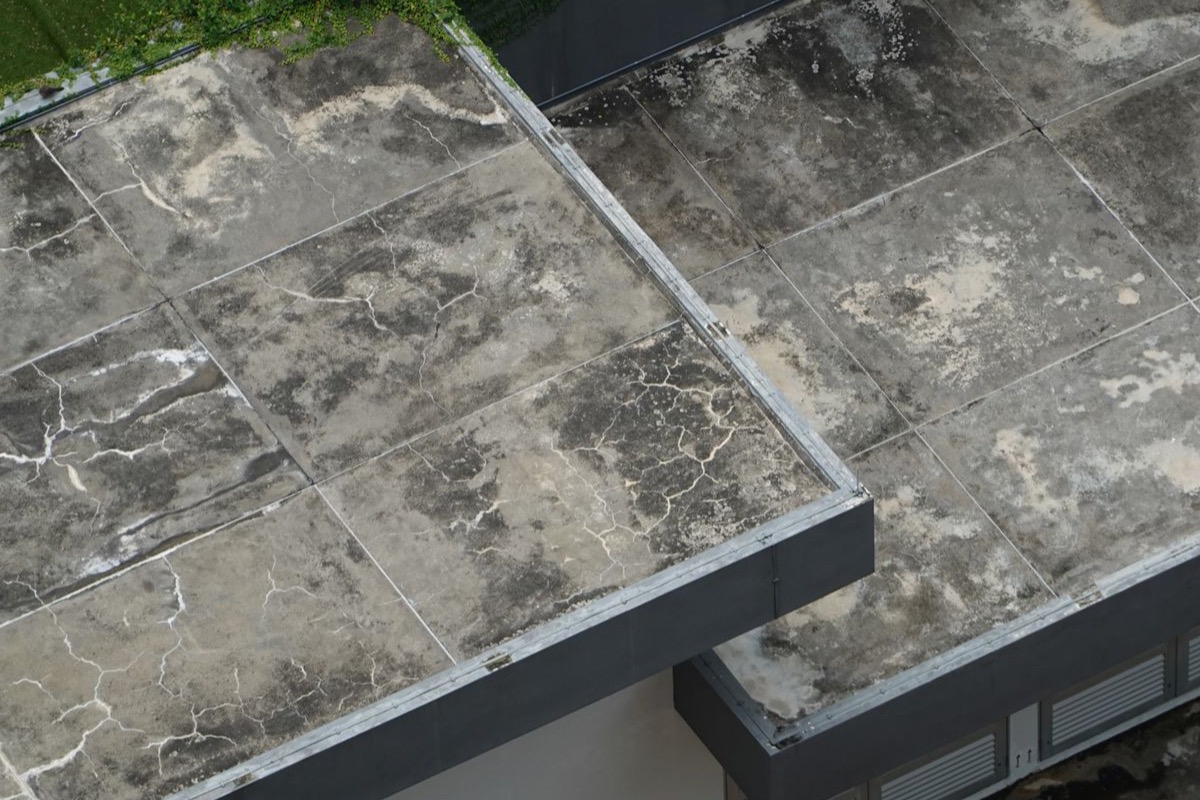
A reinforced-concrete flat roof in Singapore takes sustained monsoon rain, intense UV and daily thermal cycling. Water that cannot drain quickly ponds, and standing water finds every weakness: a hairline crack in the screed, a tired sealant at a movement joint, a poorly formed upstand, or a rainwater outlet that was never dressed properly. These details, not the open field, are where most roofs begin to leak.
Ponding usually points to inadequate falls rather than a failed coating. If the roof does not drain, water sits, thermal movement works the substrate, and any coating is asked to do a job it was never meant to do. Waterproofing seals and sheds water; it does not create drainage. That distinction shapes every sound repair.
Because the failures cluster at defects and junctions, diagnosis comes first. Where seepage appears to travel through the slab from the underside rather than the roof surface, that is a different investigation covered in water-seepage-through-concrete. The table below maps the common roof symptoms to their likely cause and to what the coating system must actually do.
| Roof issue | Likely cause | What the system must do |
|---|---|---|
| Active leak at a rainwater outlet or upstand | Poor detailing, no dressing into the outlet, cracked upstand fillet | Reinforce and dress the coating into the outlet and up the upstand as a continuous detail |
| Persistent ponding | Inadequate falls to drain, blocked or sunk outlets | Correct falls with screed-to-falls before coating; a coat alone will not cure ponding |
| Cracked screed or opened movement joint | Thermal and structural movement, brittle screed | Repair, then bridge with a flexible detail and a movement-accommodating body coat |
| UV chalking of an old coating | Non-UV-stable film left exposed to direct sun | Overcoat with a UV-stable aliphatic finish after assessment and prep |
| Blistering of the membrane | Trapped moisture or coating a wet slab | Confirm the substrate is dry or mat-damp per the primer, then reprime and recoat |
| Leak at a parapet or slab junction | Discontinuity where field meets vertical or another element | Form a continuous, reinforced upstand and termination detail |
The system approach: repair, falls, prime, body coat, finish
Waterproof performance on an RC flat roof comes from the system, not from any one product, and it fails at defects, so repair is the first step. Sound, honeycombed or cracked concrete is made good with Sparco Epoxy Mortar or the sag-resistant Sparco Epoxy Thixotropic Compound, which hardens without shrinkage. Where ponding is present, the falls are corrected with a screed-to-falls so the finished roof drains to its outlets; the gradient follows SS 637 and the project specification rather than any figure quoted here.
On a clean, sound substrate, Sparco Epoxy Bonding Primer #100 is used because it is damp-tolerant, accepting a dry or damp surface within its stated moisture limit. The seamless, flexible body coat, such as Sparcofloor WBE 400, is then applied to form the continuous water-shedding layer. Surface preparation and moisture testing are technical steps in their own right and are covered in concrete-surface-preparation-guide and concrete-moisture-testing-before-coating.
Because the roof is exposed to direct sun, the body coat is protected by a UV-stable water-resistant finish, such as Sparco Hybrid Urethane or the aliphatic, non-yellowing Sparcofloor PU 41. Where the roof carries foot traffic or plant access, a broadcast aggregate can be worked into the finish to give anti-slip texture. Product selection should be confirmed through technical review against substrate and exposure.
-
RC slab
Structural deck; repaired and made good first
-
Screed-to-falls
Corrects falls so the roof drains to outlets
-
Damp-tolerant primer
Bonds coating to a dry or damp substrate
-
Seamless flexible body coat
Continuous water-shedding layer over the whole field
-
UV-stable finish
Aliphatic top layer resists sun and weather
A representative exposed coating build-up; the flexible body coat does the water-shedding work.
Exposed versus protected and inverted roofs
An exposed system leaves the coating as the visible surface, which is direct and easy to inspect but demands a UV-stable aliphatic finish, since a body coat left in the sun will chalk and degrade. This is the simplest arrangement for a plain accessible or non-trafficked roof.
A protected or inverted arrangement buries the waterproofing under a screed, tiles, pavers or a green-roof build-up, shielding it from UV and mechanical damage at the cost of harder access if a leak occurs. Rooftop gardens, planter boxes and landscape decks are common in Singapore and place their own demands on the waterproofing and its detailing; planter-box-waterproofing covers that case, and the broader format choice between coatings and sheet membranes is set out in the pillar guide at types-of-waterproofing.
The decision turns on use, access and finish. Whichever route is chosen, the underlying discipline is the same: repair first, correct falls, and treat every junction as a detail rather than an afterthought.
Detailing that decides the result
On a flat roof, success is roughly 80 percent detailing and falls and 20 percent the field membrane. The open field rarely fails; parapets, upstands, rainwater outlets and movement joints do. Each of these needs a continuous, often reinforced, termination rather than a coating simply run up to an edge.
Upstands should carry the coating well above the finished level and terminate into a chase or under a flashing so water cannot track behind it. Rainwater outlets need the coating dressed down into the outlet so there is no break at the very point water concentrates. Movement joints must be treated as moving joints, with a detail that accommodates cycling rather than a rigid fill that will crack.
This is also where honest expectation-setting matters. A coating sheds and seals water, but it cannot hold ponded water indefinitely, and it cannot make a roof drain that has no falls. The most durable roofs are the ones where drainage and detailing were solved before the first coat went down.
- Parapets and upstands: carry the coating high and terminate into a chase or flashing
- Rainwater outlets: dress the coating into the outlet with reinforcement
- Movement joints: use a movement-accommodating detail, not a rigid fill
- Penetrations and pipes: form a collar and seal continuously to the field
Common mistakes
Most flat-roof coating failures in Singapore trace back to a small set of avoidable errors. Recognising them before work starts saves an early recoat.
The recurring mistakes are treating the coating as a cure for problems that are really drainage or detailing problems, and applying it in the wrong condition.
- Coating over ponding without first correcting the falls to drain
- Leaving a non-UV-stable body coat exposed instead of finishing with an aliphatic top layer
- Ignoring outlet, upstand and movement-joint detailing and relying on the open field
- Coating a wet slab outside the primer's moisture limit, then blistering
- Skipping defect repair, so the coating fails at the crack it was laid over
Specification checklist
Use this checklist to sanity-check a flat-roof scope before committing to it. Each item reflects a failure mode seen on real roofs.
- Defects repaired: cracks, honeycombing and spalls made good before coating
- Falls confirmed: roof drains to outlets per SS 637 and the project specification
- Substrate condition checked: dry or mat-damp within the primer's limit
- System specified in full: repair, primer, flexible body coat, UV-stable finish
- Details drawn: parapets, upstands, outlets, movement joints and penetrations
- Anti-slip provided where trafficked: broadcast aggregate into the finish
- Inspection and maintenance interval agreed with the building owner
When to use this system
- An RC flat roof is leaking at outlets, upstands or joints
- Ponding persists and falls need correcting before recoating
- An old exposed coating has chalked and needs a UV-stable overcoat
- A seamless, detailable coating suits the roof better than sheets
Where it is commonly used
- Accessible and non-trafficked RC flat roofs
- Plant decks and rooftop service areas needing anti-slip
- Protected or inverted roofs under screed, pavers or landscaping
- Multi-tenant commercial and JTC building roofs in Singapore
Related Sparco products
Recommended TDS downloads
Browse the TDS Download Centre →Related market segments
Manufacturing & Warehousing
Production floors and warehouses take forklift traffic, impact, spills and around-the-clock operations. Sparco's full flooring range — from bonding primers and repair mortars to self-smoothing epoxies and polyurethane topcoats — keeps industrial floors serviceable with minimal downtime.
Office
Commercial interiors call for clean, low-odour finishes with a professional appearance and predictable maintenance. Sparco's water-based epoxy and urethane systems provide smooth, durable floors for offices, corridors and back-of-house areas.
Related solutions & guides
Frequently asked questions
Will a roof coating stop a leak if my flat roof ponds water?
Not on its own. A coating sheds and seals water but cannot hold ponded water indefinitely, and ponding usually means the roof lacks adequate falls. The durable fix is to correct the falls with a screed-to-falls so the roof drains, then apply the coating system; the required gradient follows SS 637 and the project specification.
Do I need a UV-stable finish on an exposed RC flat roof?
Yes, if the coating is left exposed to the sun. A body coat that is not UV-stable will chalk and degrade under direct tropical UV, so an exposed roof should be finished with a UV-stable aliphatic top layer such as an aliphatic polyurethane. A protected or inverted roof buries the waterproofing and relaxes this requirement.
Can I coat directly over my existing roof screed?
Only after the screed is assessed, repaired and prepared, and the substrate condition is confirmed. Cracked or friable screed must be made good first, and the surface must be dry or mat-damp within the primer's moisture limit. Surface preparation and moisture testing are set out in the dedicated preparation and moisture-testing guides.
Why do flat roofs leak at the edges and outlets rather than the middle?
Because the open field is continuous while the junctions are discontinuities. Parapets, upstands, rainwater outlets and movement joints are where the coating meets another element, and if those details are not formed continuously, water tracks through them. On a flat roof, detailing and falls decide the result far more than the field membrane.
How long does a liquid-applied flat roof coating last in Singapore?
Service life depends on the system, the quality of detailing and drainage, UV exposure and maintenance, so no single figure applies. A well-detailed, properly drained roof with a UV-stable finish and periodic inspection lasts considerably longer than one laid over ponding or poor details. Expected life should be confirmed through technical review for the specific roof.
Related guides
Related project references
Anonymised references from real Sparco projects show how these systems are applied on comparable sites.
Browse project references →Values referenced in this guide come from the products' Technical Data Sheets. Final specification depends on substrate, traffic, chemical exposure and shutdown window — confirm the complete build-up with our technical team.